A dependable weather radio can save lives—especially where severe storms, tornadoes, hurricanes, and flash floods are common. NOAA Weather Radio (NWR) broadcasts 24/7 on seven dedicated VHF frequencies and can break in with urgent alerts even when the power or cell service fails. Below you’ll find the best models of 2026, how to choose the right one, and a quick comparison table.
Why a NOAA Weather Radio Still Matters
Unlike phone apps, NOAA alert radios don’t rely on internet or cellular networks. With Specific Area Message Encoding (SAME), you can limit alerts to your county, reducing false alarms while still getting instant warnings for tornadoes, severe thunderstorms, flash floods, hurricanes, wildfires, and other “All‑Hazards” events.
How to Choose (2026 Buyer’s Checklist)
- SAME + Public Alert certification: precise, reliable alerts.
- Power redundancy: AC + batteries; solar/crank for outages; USB for convenience.
- Audible & visual alerts: 90dB siren, flashing LEDs/strobe for sleeping or hearing‑impaired users.
- Durability: impact‑resistant body, at least basic water resistance.
- External alert jack: for strobe lights or bed shakers (accessibility).
- Phone charging: some models double as emergency power banks.
Top Picks: Best Weather Radios of 2026
1) Midland WR120 NOAA Weather Alert Radio (Best for Home)

Rock‑solid desktop alert radio with SAME programming, all 7 NOAA channels, 90 dB siren, flashing LED, and voice alerts. Stores up to 25 counties and supports English/Spanish/French. Runs on AC with 3×AA battery backup—ideal for bedrooms and central living areas.
- Pros: Simple, dependable, loud alerts, great value.
- Cons: Not rechargeable; stationary use.
2) Midland ER210 Compact Emergency Crank Radio (Best Portable)

Travel‑friendly with USB/solar/crank power, LED flashlight, and NOAA Weather Alert mode. Great for go‑bags, vehicles, and camping. Not fully waterproof, so store in a dry pouch or pack pocket.
- Pros: Compact, versatile power, SOS strobe.
- Cons: Not water‑rated; smaller battery than ER310PRO.
3) Midland ER310PRO Emergency Radio (Premium Portable with Power Bank)
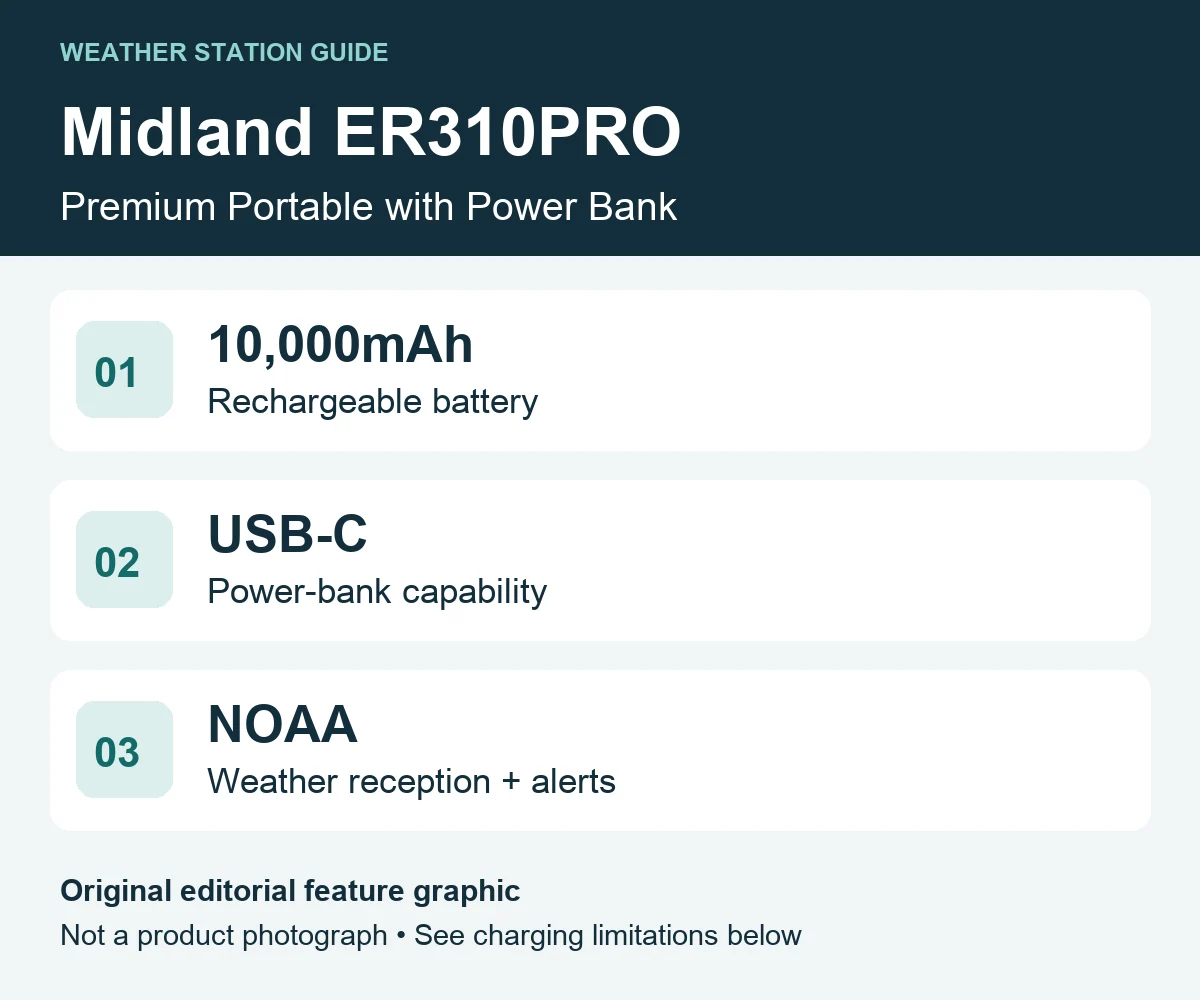
The ER310PRO fills the premium portable role with a 10,000mAh rechargeable battery and bidirectional USB-C charging/power-bank capability. It receives AM/FM and NOAA weather broadcasts, includes a weather-alert function, and adds Bluetooth audio streaming, a flashlight and SOS signaling. Solar and hand-crank charging provide supplemental charging options. See Midland’s current product information and illustrated owner’s manual for operation and limitations.
Before buying: The illustrated manual describes a sealed, nonserviceable internal battery; no AA backup is documented. It also says radio operation stops while charging an external device, so do not assume weather monitoring continues while charging a phone. Midland’s published runtime figures and some charging/battery details conflict; we do not promise a fixed runtime or user-replaceable battery.
View Midland ER310PRO on Amazon (paid link)
- Pros: 10,000mAh battery; USB-C charging and power-bank capability; NOAA weather reception and alerts.
- Cons: Sealed battery; no documented AA fallback; external-device charging interrupts radio operation according to the illustrated manual.
4) RunningSnail MD‑090P Solar Crank Radio (Best Budget)

Wallet‑friendly model with a 4000–6000 mAh power bank (varies by listing), solar + crank + USB charging, motion‑sensor reading light, and SOS beacon. Covers AM/FM and 7 NOAA channels with alerting.
View RunningSnail MD‑090P on Amazon
- Pros: Low price, big battery, lots of features.
- Cons: Analog tuning on some variants; QC can vary by seller.
5) Kaito KA500 Voyager (Best Multi‑Band)

For broader listening, KA500 adds shortwave alongside NOAA/AM/FM. Six ways to power it (including solar and crank) and a telescopic antenna improve reception when the grid is down.
6) Sangean CL‑100 Tabletop (Best Desktop Features)

Feature‑rich tabletop radio with SAME, AM/FM, large text display, adjustable alert volume, and an external alert output for strobe/bed‑shaker accessories—great for accessibility.
Quick Comparison (2026)
Setup & Maintenance Tips
- Program SAME codes for your county (find them on NOAA’s site).
- Place bedside or central so you’ll hear nighttime alerts.
- Test weekly using the NWS test; verify siren and display.
- Rotate batteries every 6 months; keep spare AAs in a dry bag.
- Add external alert devices (strobe/bed‑shaker) for accessibility.
FAQ
Do NOAA weather radios need internet or cell service?
No. They receive over‑the‑air broadcasts from local NOAA transmitters.
What’s the difference between “Weather Band” and “Weather Alert” radios?
Weather Band must be tuned and on; Weather Alert auto‑switches to warnings even if you’re listening to something else.
Is the ER210 waterproof?
No—store it dry or in a pouch when outdoors.
How far does NOAA coverage reach?
Typically ~40 miles from a transmitter, terrain permitting; an external antenna can help.
What is SAME and why is it important?
SAME (Specific Area Message Encoding) lets you program your radio to receive alerts only for selected counties or areas. This reduces false alarms and focuses warnings on where you live, work, or travel.
Which power sources should a good emergency radio have?
Ideally AC with battery backup, plus USB charging, solar, and a hand crank for redundancy during prolonged outages.
Where should I place my weather radio for best results?
Keep it in a central or bedside location so you’ll hear nighttime alerts. For reception, try near a window or high shelf, and avoid placing it behind large metal objects.
Can I add an external antenna to improve reception?
Some desktop models include an external antenna jack. If reception is weak, an external antenna or relocating the radio closer to a window can help.
What’s the difference between Public Alert and NOAA certification?
Public Alert certification ensures the radio meets standards for receiving official emergency alerts and user features, while NOAA certification confirms the radio can receive NOAA Weather Radio broadcasts.
How often should I test and maintain my radio?
Check it monthly and listen for the weekly NOAA test. Verify alerts, volume, display, and backup power, and rotate disposable batteries every 6 months.
Bottom Line
For a home base, the Midland WR120 is a safe bet. Need portability? Choose the ER210 (lightweight) or ER310PRO (larger battery and USB-C power bank; charging tradeoffs above). On a budget, the RunningSnail MD-090P packs strong features. For shortwave and robust off-grid power, grab the Kaito KA500 . Whatever you pick, a NOAA alert radio is one of the most important emergency tools you can own.