As an Amazon Associate I earn from qualifying purchases. If you buy through links on this page, I may earn a commission at no extra cost to you.
A portable lightning detector can provide additional information about nearby lightning activity. It cannot tell you that an area is safe. The right choice depends on the information you need, how you will carry or position it, and whether you want a standalone instrument or a home weather system.
The AcuRite 02020 family, original StrikeAlert and SkyScan models offer different displays and operating arrangements. This comparison uses manufacturer documentation; it does not claim hands-on testing or establish a single winner for accuracy.
Lightning safety comes before detector readings
If you hear thunder, move immediately into a substantial enclosed building with electricity or plumbing, or an enclosed metal-topped vehicle with the windows closed. Remain sheltered for at least 30 minutes after the last sound of thunder. Tents, dugouts and open picnic shelters do not provide adequate protection. Follow National Weather Service lightning guidance.
A consumer detector can miss strikes, report interference as lightning, or provide an inaccurate distance estimate. It cannot predict exactly where the next strike will occur or guarantee warning before a storm develops overhead. A quiet detector is not an all-clear signal. NOAA and OSHA explain these detection limitations.
Check forecasts and official weather alerts, monitor changing conditions, and know how to reach shelter before outdoor activities begin. Do not wait for a detector alarm or an official warning to react to thunder: NWS does not issue a separate warning for every lightning threat. A detector must not decide whether you remain outdoors or resume an activity.
Portable lightning detectors compared
The ranges below are manufacturer specifications, not independently measured performance, guaranteed coverage or safety boundaries.
| Option | Specifications and considerations |
|---|---|
| AcuRite 02020 family | Practical reason to consider it: Pocket unit with strike count and estimated distance on an LCD Manufacturer range: Up to 25 miles Power and important limitation: Two AAA alkaline batteries; electrical interference can prevent detection |
| Original StrikeAlert | Practical reason to consider it: Clip-on unit with LED distance bands and optional audible alerts Manufacturer range: Up to 40 miles Power and important limitation: Two AAA batteries in the documented original model; designed for cloud-to-ground detection |
| SkyScan P5-3 | Practical reason to consider it: Larger standalone instrument with distance-band lights Manufacturer range: Up to 40 miles Power and important limitation: Six AA batteries; keep upright and distinguish it from older SkyScan versions |
These are options to evaluate for supplemental awareness, not equipment certified here for sports-event or workplace safety. For organized outdoor activities, NWS emphasizes advance planning, shelter capacity and professional detection equipment. A consumer shopping comparison cannot substitute for that planning.
What is a lightning detector?
Portable detectors receive electromagnetic signals associated with lightning and process them to estimate distance. Their readings describe detected activity; they are not a map of exactly where every strike landed.
Distance, range and storm trends
A maximum detection range says how far away the manufacturer says activity may be detected. It does not establish an evacuation countdown. A longer advertised range does not, by itself, prove better accuracy or guarantee extra time to reach shelter.
A trend based on successive distance estimates can suggest activity is approaching or departing. That is different from a compass bearing, a mapped storm track or a prediction of its next strike. Several storms and changes in detected activity can complicate interpretation.
Placement, interference and alerts
Check the manual for the exact model. Orientation, nearby electronics, batteries and alert settings matter. An illuminated power indicator alone does not demonstrate reliable reception. Learn the unit’s interference and low-battery indications before use, and troubleshoot from shelter when thunderstorms threaten.
AcuRite 02020: LCD information in a pocket unit
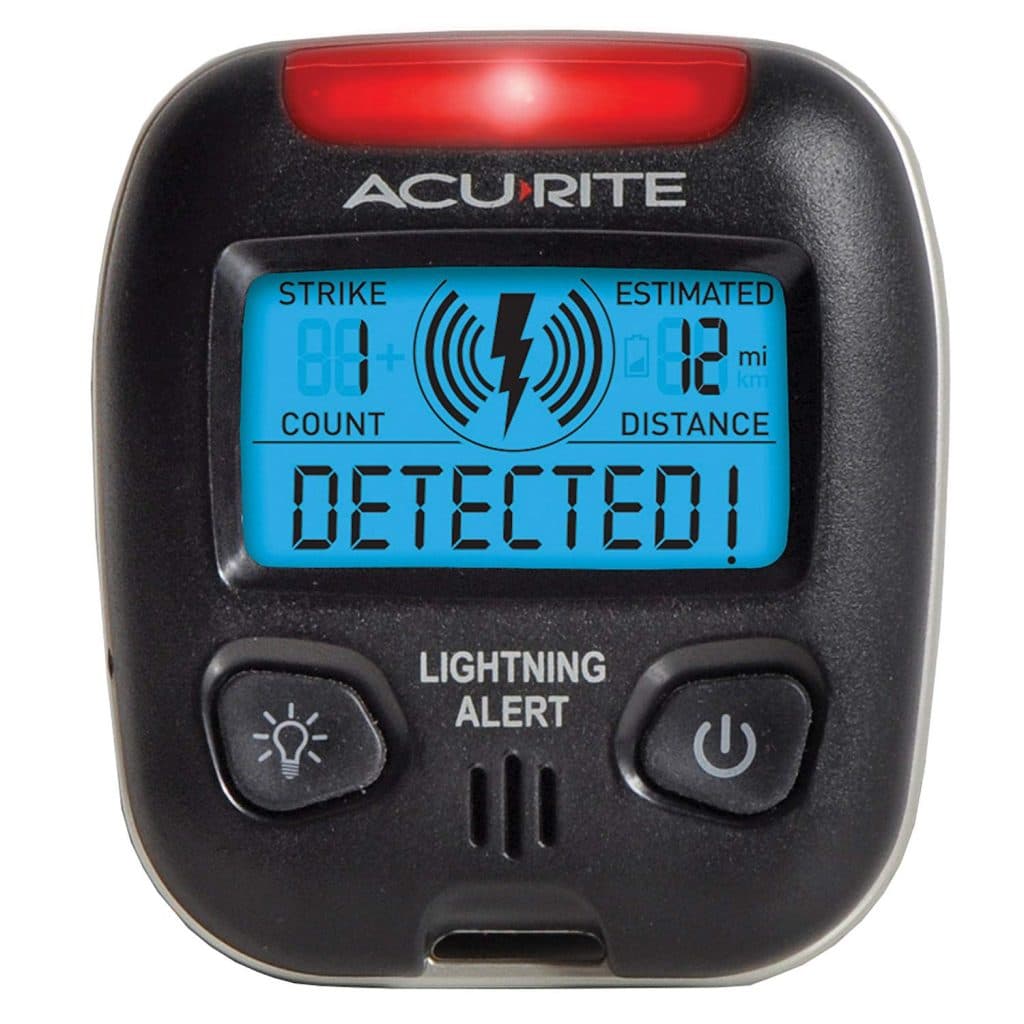
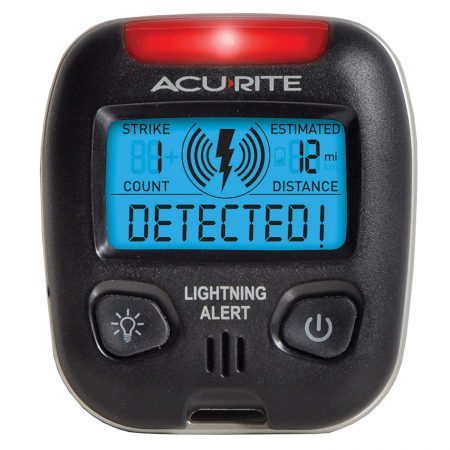
The 02020 family is a reasonable option to compare if you want a small standalone detector with a strike counter, estimated storm distance and backlight. Alerts appear on the unit through sound, a red light and display messages. “Text alert” refers to its screen, not an SMS service.
AcuRite’s current portable detector listing identifies SKU 02020CA1 and advertises detection of cloud-to-ground, cloud-to-cloud and intra-cloud activity up to 25 miles away. It was marked unavailable/backordered when reviewed; the older 02020 Amazon listing had an available offer. Neither observation establishes continued manufacturing of every variant.
Useful specifications to check:
- Two AAA alkaline batteries.
- A belt/backpack clip and backlit LCD.
- Weather-resistant construction, which should not be interpreted as waterproof.
- Indoor and outdoor modes; performance is still affected by the environment.
For an “Unable to detect…please relocate” message, AcuRite’s 02020 support guidance recommends moving the unit away from interference, including keeping it at least three feet from relevant electronics. Indoor mode changes interference sensitivity; it does not establish equal performance in every indoor and outdoor location.
Follow the manual for your variant. Its return to a listening state after a period without detected strikes must not be treated as permission to leave shelter.
Check the AcuRite 02020 listing on Amazon (paid link). Confirm the model supplied, condition and warranty before ordering.
Original StrikeAlert: LED distance bands and trend information
The original StrikeAlert remains listed by Outdoors Technologies alongside separate HD and HD Field models. It suits readers who prefer a clip-on instrument with simple lights to an LCD strike counter. The manufacturer’s product information specifies two AAA batteries and up to 100 hours of operation. That runtime is a manufacturer estimate.
The original model’s operating instructions describe four bands: 0–6, 6–12, 12–24 and 24–40 miles. Its trend indication uses approximately five minutes of detected activity. It does not provide a compass direction. Keep it upright, check whether the audible tone is enabled, and understand the two-hour shutoff when no lightning activity is detected.
The manufacturer’s FAQ says cloud-to-cloud strikes may not register and that interference or processing another strike can cause missed detections. It also distinguishes occasional light-rain exposure from submersion. Thunder still calls for shelter even without an alarm.
Use the manufacturer’s documentation to identify the model before buying. Retail listings can mix older and newer specifications, including battery types. HD features such as a graphical display and vibration should not be attributed to the original StrikeAlert.
SkyScan: identify the generation before buying
SkyScan’s current documentation identifies the P5-3 as a newer version, with six AA batteries. Its P5-3 specification sheet advertises detection up to 40 miles. This larger standalone option is worth considering if you prefer a prominent range-light display and have a suitable upright position for it.
The earlier Xtreme Research SkyScan discussed on this page used two 9V batteries. Do not transfer those battery specifications to the P5-3. SkyScan’s manuals page currently links an older two-9V manual under the P5-3 heading, so owners should confirm the correct instructions with the manufacturer if the document and hardware disagree.
For older units, the legacy manual documents 0–3, 3–8, 8–20 and 20–40-mile bands, upright placement on a stable surface, and an optional wall mount. Wall mounting is not mandatory. It also describes a separate storm-pattern alarm; that device indication is not an official Severe Thunderstorm Warning.
SkyScan’s current FAQ confirms the P5-3’s upright-placement requirement and susceptibility to electrical interference. Its cloud-lightning filtering is another reason not to interpret silence as safety. The evidence reviewed does not support naming SkyScan the most accurate detector, and this guide does not repeat an unverified percentage-accuracy claim.
Check the SkyScan P5-3 listing on Amazon (paid link). This is a third-party offer; check the seller, dispatch estimate and return terms before ordering.
What about a home weather station with lightning detection?
A home system serves a different purpose from a portable alarm. For example, Tempest includes a lightning sensor, a solar-powered outdoor device and a powered Wi-Fi Hub. Its system documentation describes cloud and ground lightning detection up to approximately 25 miles and recommends an internet connection for full operation.
Tempest’s lightning documentation explains that reported observations can be checked against nearby stations and third-party data, with false-strike filtering and missed-strike correction. App notifications are also filtered rather than sent for every strike. That cloud-supported reporting differs from the three standalone detectors above; connectivity and notification delivery are additional dependencies.
Consider this route when you also want broader home weather observations. It is not a pocket detector replacement or a reason to buy a complete station solely to determine outdoor safety. An internet-connected weather station does not necessarily include lightning detection—verify its specific sensors and compatible accessories.
Choosing an option
Compare AcuRite for a pocket LCD and strike count, original StrikeAlert for a simple clip-on LED interface, and the current SkyScan generation for a larger upright instrument. Consider a home system separately if you need ongoing weather observations.
There is no defensible universal accuracy winner in the evidence reviewed here. Choose based on documented functions and operating limitations, while keeping forecasts, official guidance and a practical shelter plan at the center of your decisions.