Disclosure: This post contains affiliate links. If you buy through them I may earn a small commission at no extra cost to you.
I’ve spent a lot of time with both the WeatherFlow Tempest and the Ambient Weather WS-5000, and I’ll tell you upfront — this is one of the more interesting comparisons in the home weather station world right now. Both use ultrasonic wind sensing with no moving parts, both are genuinely smart-home capable, and both sit in the premium tier of the market. But they’re built around completely different philosophies, and that matters a lot when it comes to which one belongs in your yard.
Let me break it down.
Quick Answer: Who Should Buy Which
If you want the simplest possible setup, built-in lightning detection, and a sleek one-piece sensor, get the Tempest. If you want a physical display console, more expandability, and a more traditional (but still ultrasonic) station experience, get the WS-5000.
Now let me explain why.
Design and Setup
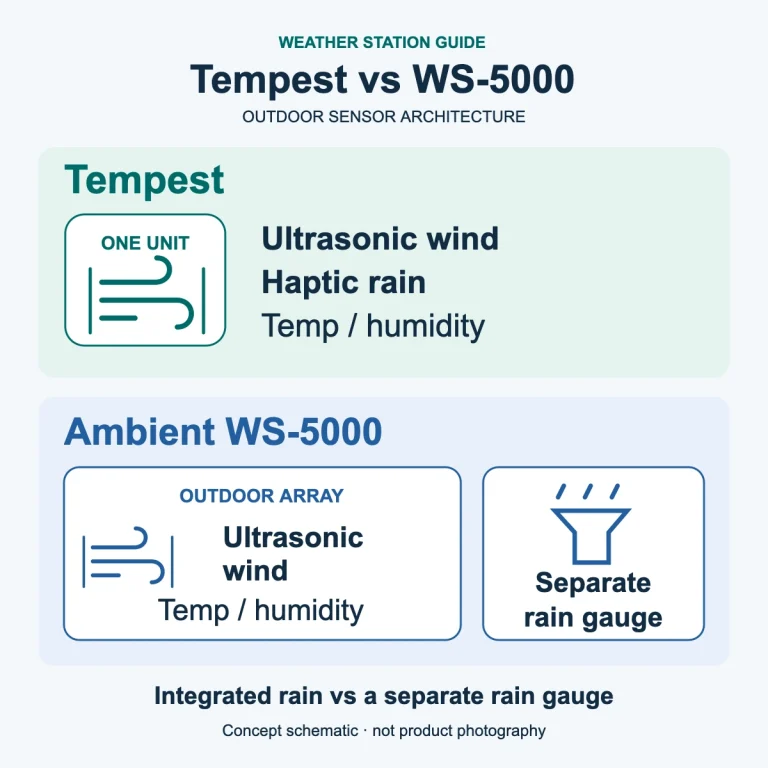
The Tempest is one of the most elegantly designed weather stations I’ve seen. Everything — wind, rain, temperature, humidity, UV, lightning — is packed into a single cylindrical unit about the size of a large coffee mug. You screw it onto a pole, connect the hub to your Wi-Fi, and you’re done. I’ve seen people get it running in under 10 minutes. There’s genuinely nothing to assemble.
The WS-5000 takes a more traditional approach. You’ve got a separate sensor array, a dedicated rain gauge cup, an indoor temperature/humidity/barometer sensor, and a TFT color LCD console that plugs into the wall. Setup took me closer to 45 minutes, and a couple of sensors didn’t auto-connect the first time. It’s not hard, but it’s definitely a more involved install than the Tempest.
Winner for setup: Tempest, by a mile.
Wind Measurement
This is where both stations earn their premium price tags. Both use ultrasonic anemometers — meaning no spinning cups, no wear, no bearings to seize up in ice or dust. During an ice storm, the WS-5000 continued to stream data while nearby mechanical stations reported 0 mph with frozen bearings. The Tempest would have done the same.
The Tempest’s ultrasonic anemometer samples every 3 seconds and follows World Meteorological Organization standard methods. The WS-5000’s sensors have also shown strong accuracy in third-party testing, outperforming lower Ambient models. In day-to-day use, both are excellent. I wouldn’t make my decision based on wind accuracy alone.
Winner: Tie — both are genuinely excellent.
Rain Measurement
This is where things get more nuanced, and I want to be honest with you because it’s the most-discussed limitation of the Tempest.
The WS-5000 uses a traditional tipping-bucket rain gauge with an extra-large collection funnel — a proven and reliable method that’s been around for decades.
The Tempest uses a patented haptic rain sensor that measures rainfall by detecting the vibration of raindrops striking the top of the unit. It’s genuinely innovative — and it detects rain start within seconds, which is great for smart home automations. But mount materials, mast height, environment, wind, and turbulence can all affect the accuracy of the haptic readings, and the sensor benefits from manual calibration to perform at its best. Vibration from wind on an unstable mount can even trigger false rain readings.
Rain sensor accuracy has improved significantly since the Tempest’s launch, but it remains a point of variability depending on how and where you mount it. If precise rainfall totals matter to you — for a garden, for data logging, for comparing against a manual gauge — the WS-5000’s tipping bucket is the more reliable choice.
Winner for rain accuracy: WS-5000.
Lightning Detection
The Tempest wins this one outright. Lightning detection is one of its standout features — it can detect strikes up to 40 km away and regularly detects distant lightning faster than other stations on the market. If you live in a storm-prone region — the South, the Plains, or anywhere thunderstorms roll through regularly — this alone might be the deciding factor.
The WS-5000 does not include lightning detection in the base package. You can add a lightning sensor as an optional accessory, which will cost you extra.
Winner: Tempest, and it’s not close.
Smart Home Integration
Both stations work with Alexa, Google Home, and IFTTT. The Tempest also integrates with platforms like Weather Underground, MyRadar, and Carrot Weather. HomeKit is not yet supported on the Tempest, which is a real limitation if you’re deep in the Apple ecosystem.
The WS-5000 connects to the Ambient Weather Network (AWN), which has a solid community dashboard and data-sharing features. An AWN+ subscription unlocks extras like forecasting and air quality data. The Tempest app is free and includes AI-enhanced hyperlocal forecasting at no extra cost — which I think is a genuine edge for most buyers.
Winner: Tempest (better app, no subscription needed for core features). WS-5000 if you want a native display console or are in the Google ecosystem.
Expandability
The WS-5000 is in a different league here. You can add air quality sensors, soil moisture, water temperature sensors, and a lightning detector — all reporting to the console every five seconds. If you’re someone who wants to build out a full home weather ecosystem over time, the WS-5000 is the obvious platform for it.
The Tempest is a closed, all-in-one system. What you buy is what you get, sensor-wise. That’s part of what makes it so elegant and easy to use, but it’s a real limitation if your monitoring needs grow.
Winner: WS-5000.
Display Console
The Tempest has no physical console. You view everything through the app on your phone or browser. For a lot of people that’s completely fine — I mostly check my weather data on my phone anyway. But if you like a dedicated glanceable display on your desk or wall, the WS-5000’s color TFT LCD is a genuinely nice feature. All key readings are large enough to read from several feet away, though with all optional sensors connected it can get a bit crowded on screen.
Winner: WS-5000.
Price
Prices fluctuate, so always check the current listing on Amazon — but as a general guide: the Tempest typically runs around $330–$340. The WS-5000 base unit is in a similar range, though the IP3 version (app-only, no display console) runs closer to $250. Add optional sensors to either and costs climb quickly.
Side-by-Side Comparison
| WeatherFlow Tempest | Ambient WS-5000 | |
|---|---|---|
| Setup difficulty | Very easy (~10 min) | Moderate (~45 min) |
| Wind sensing | Ultrasonic | Ultrasonic |
| Rain measurement | Haptic (mount-sensitive) | Tipping bucket (reliable) |
| Lightning detection | Built-in (up to 40 km) | Add-on sensor only |
| Display console | None — app only | Yes — color TFT LCD |
| Expandability | Limited (all-in-one) | Extensive (8+ sensors) |
| Smart home | Alexa, Google, IFTTT | Alexa, Google, IFTTT |
| App / subscription | Free app, no subscription | Free + optional AWN+ |
| Best for | Smart home, storm watchers | Data enthusiasts, gardeners |
The Bottom Line
Choose the Tempest if: You want the simplest setup possible, lightning detection is important to you, and you’re happy managing everything through an app.
Choose the WS-5000 if: You want a physical console, plan to expand your sensor ecosystem over time, or need the most reliable rainfall measurements possible.
Both are genuinely excellent stations and a big step above anything in the budget category. You won’t be disappointed either way — but understanding what each one is designed for will save you a lot of second-guessing after you’ve already spent $300.
👉 Check price of the WeatherFlow Tempest on Amazon
👉 Check price of the Ambient Weather WS-5000 on Amazon
Not sure either of these is the right fit? Check out my full buying guide to home weather stations to see how these two stack up against the rest of the field.