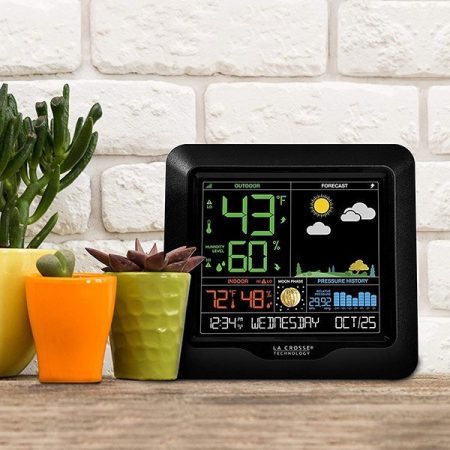
The La Crosse S84107 is an indoor color display with a wireless outdoor temperature/humidity sensor. It is useful for checking conditions around your home, but it is not a Wi-Fi station, rain gauge or lightning detector.
Check the model label first. La Crosse marks the original S84107 as retired but still provides manufacturer documentation, with separate documentation for S84107V2. The instructions below concern the original S84107. If your label includes V2, use the manufacturer’s manual selector instead of assuming every button sequence is identical.
As an Amazon Associate I earn from qualifying purchases. If you buy through links on this page, I may earn a commission at no extra cost to you.

Original manual and first setup
Keep the original S84107 manual nearby. For initial setup:
- Put two fresh AA batteries in the outdoor sensor, observing polarity.
- Connect the indoor display to its specified 5V adapter. Three AA batteries provide optional backup; battery-only operation changes the backlight behavior.
- Leave the units nearby while they connect. The manual says to wait five minutes before moving the sensor outside.
- Check outdoor readings before choosing a permanent mounting position.
This is a sensor-to-display radio connection, not Wi-Fi pairing. The original instructions use SEARCH to reacquire the sensor; they do not describe a three-channel selection procedure. Avoid borrowing pairing instructions from another La Crosse station.
Outdoor readings missing? Try reconnection first
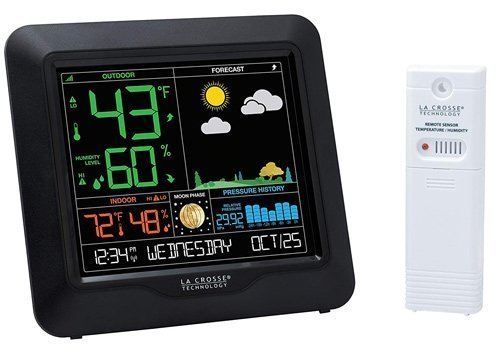
The S84107 support instructions explain that the display can retain the last reading for ten minutes before showing dashes. Dashes indicate missing reception; they do not automatically establish that the sensor has failed.
Bring the sensor close to the display, check its batteries and hold SEARCH until the sensor-search indicator starts. If it still fails, the original troubleshooting FAQ recommends removing the sensor batteries for two minutes, reinstalling them, then holding SEARCH for five seconds. Allow ten minutes for reconnection.
Factory reset erases recorded history and returns the station to its default setup. Record anything you need first. If the preceding checks fail, the original-model FAQ specifies fresh sensor batteries, the sensor within five feet, and holding ALERTS and LIGHT together for five seconds. Allow up to three minutes to reconnect, then restore your settings. Use the V2 documentation for V2 hardware.
Sensor placement and realistic range
Mount the sensor vertically in a shaded, sheltered location, such as a north-facing wall beneath an eave. It is weather resistant, not waterproof. Direct sun, heated walls and exposed wet locations can undermine useful temperature readings. Test reception before fastening it permanently.
La Crosse’s original manual lists up to 330 feet in open air; its product page and FAQ give 300 feet. Treat those as ideal-condition figures, not a promise indoors. Walls, metal, windows and other obstructions can reduce communication distance substantially. Our Sensor Siting Checklist explains practical placement compromises.
Atomic time and manual clock settings
The clock receives WWVB radio time; it does not obtain time over the internet. Enable atomic reception and select the appropriate time-zone/daylight-saving settings. Reception is often better at night and can be affected by building materials and electronics. NIST’s WWVB guidance explains why reception is not guaranteed everywhere indoors.
For manual setup, hold SET for three seconds, use +/− to change values and press SET to advance through the settings. LIGHT exits. The manual distinguishes a brief SEARCH press for WWVB from holding SEARCH for the outdoor sensor. Use the clock manually if reception is unreliable.
Forecast icons, readings and alerts
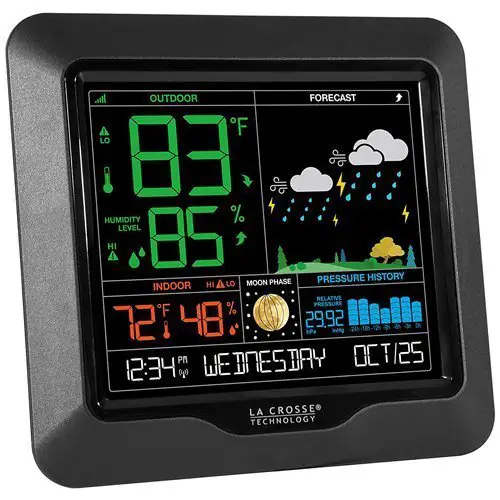
Outdoor temperature and humidity come from the sensor. Forecast icons are different: the station interprets pressure changes to suggest upcoming conditions. La Crosse specifies a seven-to-ten-day learning period and describes the icons as a forecast for the next twelve hours. They are not a guarantee or an official severe-weather warning.
The display also provides temperature/humidity high and low records, heat index, dew point and a 24-hour pressure-history graph. Its moon and seasonal graphics are calendar-based features, not additional outdoor measurements.
Temperature/humidity alerts are thresholds you configure. They do not guarantee notification of dangerous weather. Hold ALERTS to enter alert setup and follow the manual’s sequence; silencing a sounding alert does not necessarily disable it.
Backlight and power checks
With adapter power, LIGHT cycles through the original model’s backlight levels. On batteries alone, illumination lasts about ten seconds after a button press. A dark battery-powered display therefore does not necessarily indicate a fault.
An indoor low-battery icon concerns the display batteries; an outdoor icon concerns the sensor. For adapter replacement, use the part linked from La Crosse’s S84107 product page and confirm the model with support rather than selecting a generic adapter by voltage alone.
Replacing a failed sensor—or buying a station
The original package used TX141TH-BV2. La Crosse lists TX141TH-BV4 as a compatible replacement. Confirm that your label identifies the applicable original S84107 configuration before buying. If battery, placement and reconnection checks fail, check the La Crosse TX141TH-BV4 replacement temperature/humidity sensor on Amazon (paid link). This is the sensor only, not a complete station. Similar appearance or radio frequency does not establish another sensor’s compatibility.
For a new purchase, La Crosse separately lists the S84107V2. Check that version’s documentation. If you need internet access, explore Wi-Fi weather-station considerations; for a simpler temperature display, see our outdoor-thermometer guide. Neither changes what the original S84107 can do.